Why an Economist Chose Fiction Over Financial Formulas
An immigrant finance guide becomes a memorable fable about resilience, belonging and financial confidence.
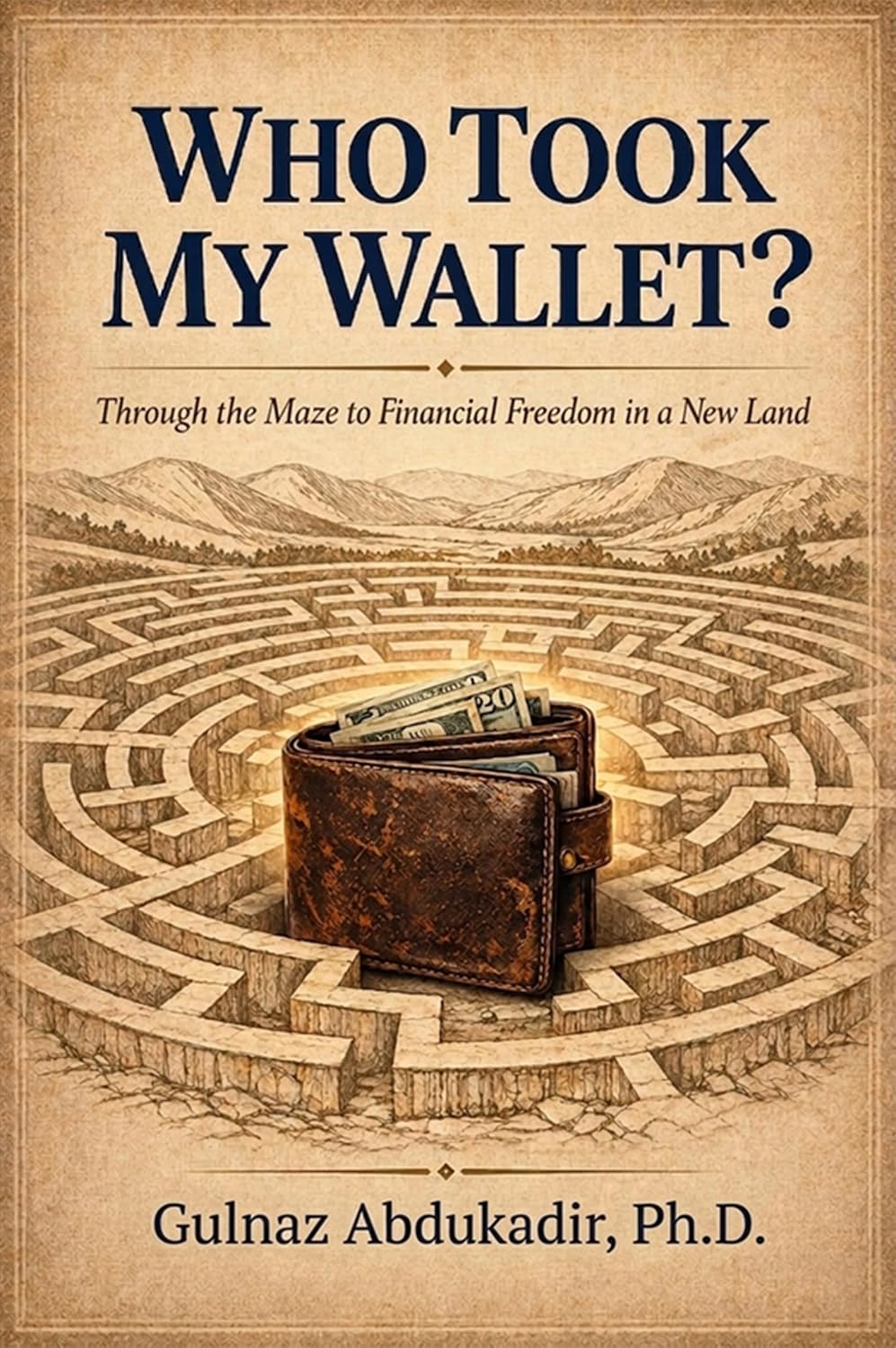
Summary: Rather than writing another personal finance handbook, economist Gulnaz Abdukadir transforms decades of financial expertise into a business fable that explores how immigrants navigate unfamiliar financial systems through story, community and resilience. Blending economics with poetry, Who Took My Wallet? argues that lasting financial confidence begins not with formulas, but with understanding the human experiences behind money.
Who Took My Wallet?: Through the Maze to Financial Freedom in a New Land Gulnaz Abdukadir. Emberlight Press, 2026.
When Gulnaz Abdukadir decided to write about personal finance for immigrants, she began where most economists would: with a handbook. Drawing on lectures she had delivered for the Uyghur Academy on retirement planning, the stock market, Medicare, Medicaid and estate planning, she set out to translate the mechanics of the American financial system.
Then she reconsidered.
Would readers remember charts and formulas a year later? Probably not, she concluded.
That realization transformed her project into Who Took My Wallet?: Through the Maze to Financial Freedom in a New Land, a concise, 127-page business fable that exchanges spreadsheets for storytelling. Rather than presenting financial concepts through checklists and graphs, Abdukadir follows four immigrants—a scholar, an investor, a refugee and a hustler—as they navigate a maze of promises, setbacks and difficult choices that mirrors the American financial system. Short poems punctuate each stage of the journey, reinforcing the book's central conviction: people remember stories long after they forget statistics.
For readers expecting a conventional personal finance guide, that decision may come as a surprise. Yet it is precisely what distinguishes Who Took My Wallet? from countless books promising financial success through formulas alone.
Abdukadir, who spent a decade at the World Bank and more than two decades in the financial industry, argues that financial security in a new country cannot be reduced to arithmetic. As she explained in an interview with Edgu Bilig, economics can describe how markets function, but it cannot fully explain why people fear money, misunderstand it or make the choices they do. Behind every financial decision, she argues, lies a story shaped by hope, sacrifice, anxiety and lived experience.
That perspective gives the book its greatest strength. Rather than treating immigrants as people who simply need better budgeting skills, Abdukadir recognizes that many arrive with professional experience, strong work ethics and stable incomes yet remain unfamiliar with America's financial vocabulary—credit scores, mortgages, retirement plans, insurance, taxes and investing. The challenge is not laziness but translation.
The four travelers who populate the story never escape the maze through clever investing or relentless work alone. They move forward by sharing knowledge, resources and trust. Community, rather than individualism, becomes the book's guiding principle. The Uyghur tea gathering that anchors the narrative reflects the kinds of informal support networks many immigrant communities build as they establish new lives.
That emphasis on community also keeps the allegory grounded. Although inspired by the Uyghur experience, the questions Abdukadir raises extend well beyond one diaspora. Whether newcomers arrive from Central Asia, Latin America, Eastern Europe or elsewhere, many confront similar uncertainties: How do I rebuild my life? How do I protect my family? How do I belong in a place whose financial rules differ from everything I have known?
Perhaps the book's most unexpected element is its use of poetry. Rather than interrupting the narrative, the poems create moments of reflection, reminding readers that financial decisions rarely emerge from logic alone. They grow out of memory, fear, displacement and aspiration. In that sense, Who Took My Wallet? occupies an unusual space between financial guide, immigrant narrative and literary fable.
Readers looking for detailed investment strategies or retirement calculations will not find them here. That is a deliberate choice. Abdukadir set aside the handbook she originally intended to write in favor of a story she hoped readers would remember long after the practical details faded.
The result is less a manual about managing money than a meditation on rebuilding confidence, community and belonging in a new country. For immigrants navigating unfamiliar financial systems—or for anyone interested in the human dimensions of economics—that may prove the book's most enduring lesson.