How Kazakh Robotics Teams Bring Hospitality to One of the World’s Fiercest STEM Competitions
Kazakhstan robotics teams blend engineering, hospitality and mentorship at Houston’s global FIRST championship.
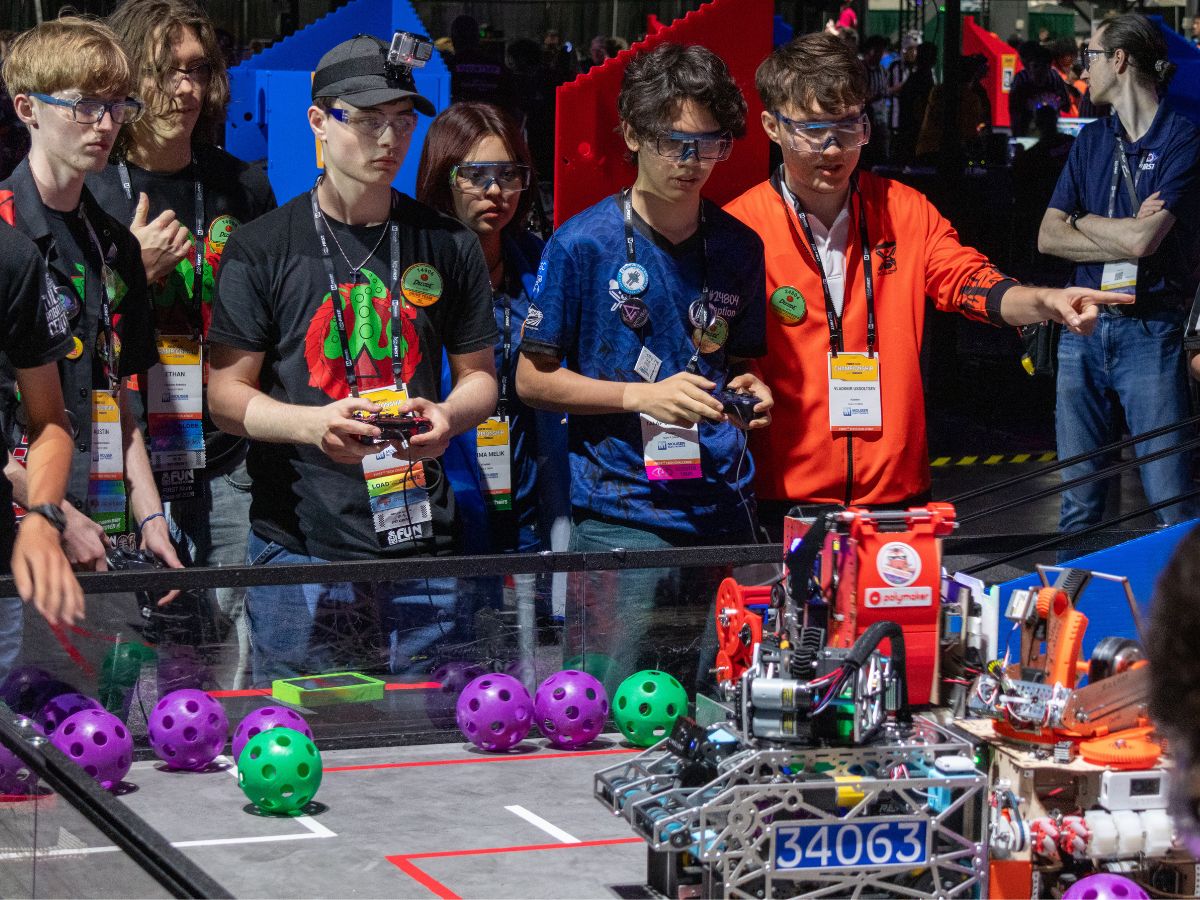
At the 2026 FIRST Robotics Competition World Championship in Houston, more than 250 Kazakh students arrive not only to compete in robotics but to represent a broader culture of hospitality, mentorship and community outreach. Through tactile engineering projects, inclusive STEM initiatives and mentorship programs for younger students, teams like Overtime, Panheya and Foxslide reveal how Kazakhstan’s rapidly growing robotics movement extends beyond competition and into cultural identity, accessibility and responsibility toward future generations.
Behind the Overtime team’s booth at Houston’s George R. Brown Convention Center, a large Kazakh flag stretches across the back wall in turquoise and white. Around it, subtle reminders of home soften the sharp lines of robotics parts and engineering diagrams: a souvenir-sized yurt, bowls traditionally used for kymys or chai now filled with chocolate and a felt children’s book with Velcro pieces that allow infants to take their first tactile steps into engineering.
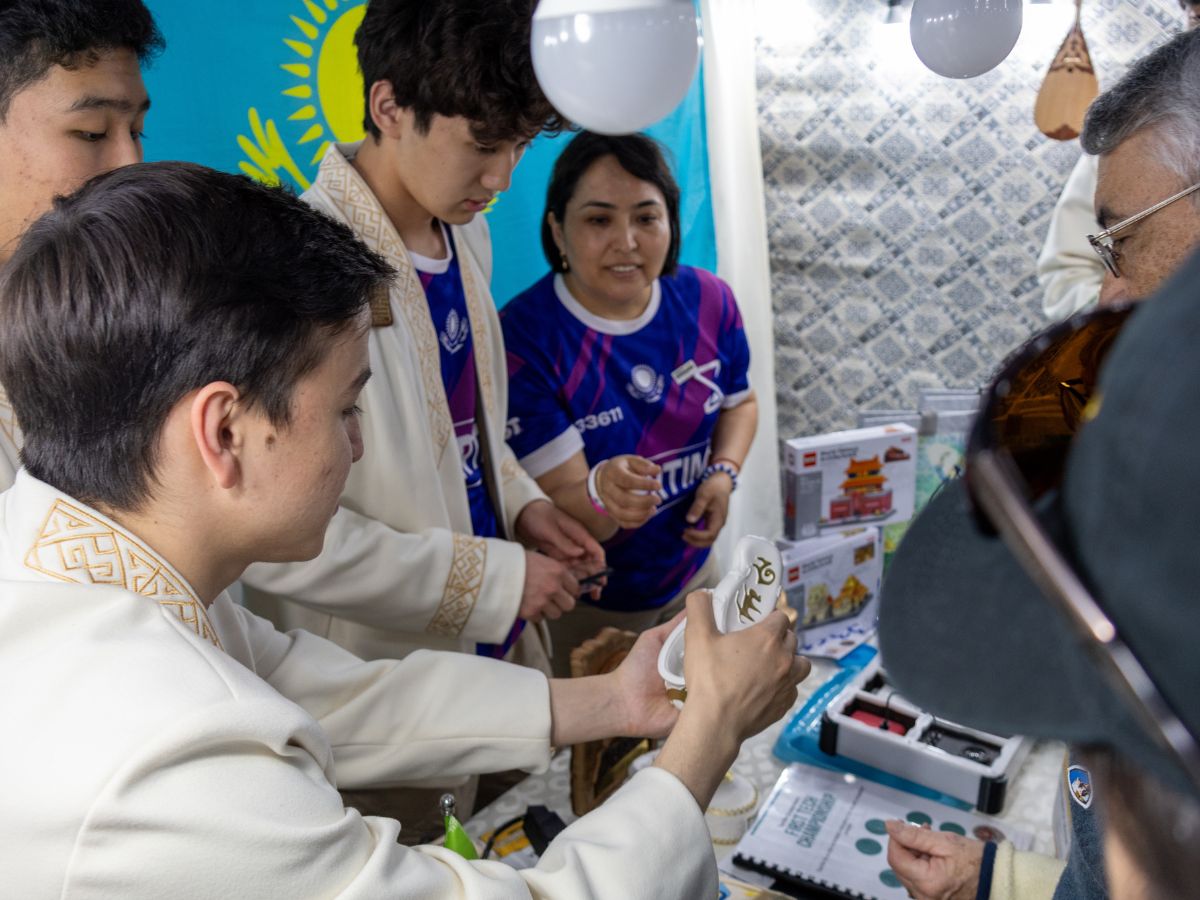
At the 2026 FIRST Robotics Competition World Championship in Houston, more than 250 students arrive from Kazakhstan to compete in robotics, as much a show of hospitality, mentorship and community as it is STEM know-how. Above team Overtime, Lead by Irisbek Ulugbekov demonstrate their innovations at the Houston championship.
Nearby, Overtime outreach lead Yersultan Aryn lifts another project toward a passerby—a tactile robotics manual designed for blind and low-vision students. The manual includes an entire book printed completely in Braille alongside a box of differently shaped robotic pieces that students physically assemble into a complete robot while learning engineering concepts through touch.
“You should be kind to everyone,” Aryn says as visitors gather around the booth. “You should be inclusive.”

Overtime team Irisbek Ulugbekov and outreach lead Yersultan Aryn
Beside him, team captain Irisbek Ulugbekov explains the mechanics behind the team’s robot while offering guests chocolate from the wooden bowl. Around them, teammates in matching white shapan overcoats greet students, judges and mentors moving through the crowded walkways of the 2026 FIRST Robotics Competition World Championship.
For Kazakhstan’s students, hospitality becomes part of the presentation itself.
At this year’s championship, more than 50,000 students, mentors, educators and supporters from around the world gather in Houston for one of the world’s largest youth robotics competitions. Among them are more than 250 students from Kazakhstan representing 12 teams — one of the largest international delegations at the event and part of a rapidly growing robotics movement that increasingly blends engineering with outreach, mentorship and cultural identity.
For many of the students, the competition is not simply about robots.
It is about how Kazakhstan presents itself to the world.
“Kazakh people are all about hospitality,” says Panheya outreach lead Aibarly Tleuberdi. “When someone knocks at your door, you let them in.”
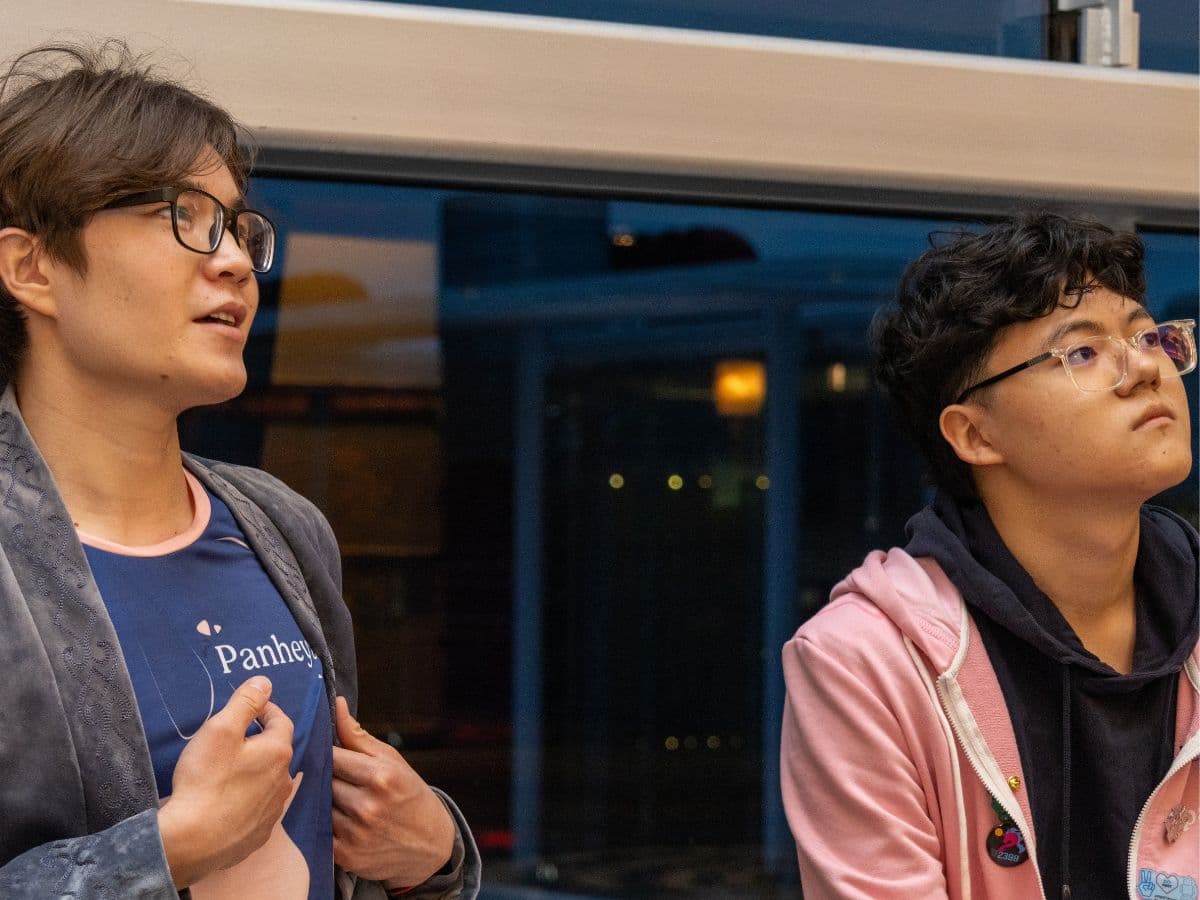
Panheya outreach lead Aibarly Tleuberdi (right) and team captain and founder Mukhammedzhan Kadirov (left). As Panheya’s outreach and community engagement lead, Tleuberdi oversees initiatives extending far beyond the robot itself. One of the team’s largest projects, Girls Go First, organizes workshops, forums and mentorship programs encouraging girls to pursue STEM education.
That idea surfaces repeatedly across conversations with students from different cities and teams throughout the championship. While the robots remain central to the competition, many students describe outreach, mentorship and generosity as equally important parts of FIRST culture.
FIRST Robotics programs place heavy emphasis on “gracious professionalism,” a philosophy encouraging teamwork, mentorship and collaboration alongside technical competition. For many Kazakh students, those values feel deeply familiar.
More than 900 years ago, the Turkic scholar Mahmud al-Kashgari documented the languages and cultural traditions of the medieval Turkic world in the Dīwān Lughāt al-Turk. There he wrote, “Tutgıl konuk agırlıg”—“Hold the guest in high honor.” The phrase shares its linguistic root with the modern Kazakh word for hospitality, qonaqzhailyq, reflecting the deeper Turkic cultural traditions from which the Kazakh language emerges.
“We are not planning to be hospitable,” Ulugbekov says. “It comes out really naturally.”
Across the convention center, hundreds of students move between competition fields carrying batteries, tools and laptops while judges gather around booths evaluating outreach initiatives as carefully as engineering performance. Teams exchange pins, flags and gifts while students explain robots to visitors from countries they may have never encountered before.
Within Kazakhstan’s delegation, however, the atmosphere also carries another layer: visibility.
Several students describe spending as much time explaining Kazakhstan itself as they do explain their robots. At booths throughout the convention center, teams hand out brochures about their country, answer questions about Kazakh culture and correct misconceptions they say still shape how outsiders view Central Asia. One student recalls being asked whether the film Borat accurately represented Kazakhstan.
“There are obviously some prejudice[s] about our country,” Tleuberdi says. “And to solve that, we are doing this also.”
For students like Tleuberdi, robotics becomes both technical competition and cultural representation.
As Panheya’s outreach and community engagement lead, Tleuberdi oversees initiatives extending far beyond the robot itself. One of the team’s largest projects, Girls Go First, organizes workshops, forums and mentorship programs encouraging girls to pursue STEM education.
“Girls are as capable and passionate about robotics,” Tleuberdi says. “They just need a place where they can genuinely try.”
Tleuberdi also becomes the first Central Asian ambassador for Fun FTC, an international robotics media network highlighting innovative engineering solutions from teams around the world. Through the role, he helps showcase robotics teams across Kazakhstan and Central Asia that often remain underrepresented internationally.
“Kazakhstan is excellent in engineering solutions,” Tleuberdi says. “The best thing about FIRST is that everyone has something to bring to the table.”
That same mentality shapes Overtime’s outreach work in Shymkent.
Ulugbekov says the team regularly mentors younger students and visits orphanages and underserved communities to introduce children to robotics. During one outreach visit, a child named Muristam approaches the team after a demonstration and asks a question Ulugbekov still remembers clearly:
“You will come back, right?”
The question changes how the team views outreach.
The outreach projects themselves often mirror the students’ broader understanding of hospitality. Overtime’s tactile engineering initiatives, including the Braille robotics manual and felt educational engineering book, focus on making robotics accessible to students who might otherwise feel excluded from STEM spaces.
For many teams, however, building outreach programs while simultaneously preparing competitive robots creates enormous pressure.
Panheya captain and builder Mukhammedzhan Kadirov says one of the hardest parts of leading a team involves balancing personalities, expectations and responsibilities across nearly 30 contributors, including mentors, designers and unofficial members.
“The important thing is that you have to trust,” Kadirov says. “Just give other members to do it by themselves.”
Tleuberdi says communication ultimately becomes more important than technical perfection.
As Panheya’s outreach lead, he spends much of the season navigating disagreements between the team’s technical and outreach divisions while helping coordinate community initiatives, sponsorship efforts and presentations. Team members come from different schools, competitive backgrounds and academic specializations, forcing students to learn how to collaborate under constant pressure while balancing schoolwork, competitions and outreach responsibilities.
“There’s no perfect team,” he says. “But you can always reach out for help.”

Foxslide team Mansur Khamitov and Alimzhan Aday at the 2026 Robotics Competition World Championship in Houston, Texas. The two teammates describe spending months preparing both their robot and outreach initiatives before arriving in Houston for their first world championship appearance.
The same lesson emerges for Mansur Khamitov and Alimzhan Aday of the Foxslide team from Astana’s National School of Physics and Mathematics. Standing near the competition fields between matches, the two teammates describe spending months preparing both their robot and outreach initiatives before arriving in Houston for their first world championship appearance. Around them, teams wheel robots through crowded hallways while judges and mentors move between pit areas evaluating engineering notebooks, presentations and community impact projects.
“We were scared about the teams,” Aday admits about arriving in Houston for the first time. “How strong the teams are going to be.”
Like many Kazakh teams, Foxslide spends months balancing engineering work with outreach responsibilities. Khamitov says their team regularly mentors newer robotics groups in less-developed regions across Kazakhstan, teaching younger students how FIRST competitions work and helping them avoid the mistakes they made themselves.
“We’re just sharing our experience,” Khamitov says.
That mentorship culture grows alongside Kazakhstan’s expanding robotics ecosystem.
According to USTEM Foundation program delivery manager Daniyar Yermatov, Kazakhstan’s FIRST community has grown rapidly since 2020 with strong government support, increasing school participation and expanding student interest in engineering and artificial intelligence.

USTEM Foundation program delivery manager Daniyar Yermatov see expanding student interest in engineering and artifical intelligence and sees the benefits for competitions like FIRST. “You need to compete, and also you need to develop environment,” Yermatov says. “You need to develop your community, open teams, help these teams.”
“You need to compete, and also you need to develop environment,” Yermatov says. “You need to develop your community, open teams, help these teams.”
This year’s championship reflects that growth.
The Overtime team from Shymkent Intellectual School claims the Reach Award. Panheya of Almaty Medeu Intellectual School also earns recognition in the same category while becoming one of the first Kazakh teams to reach the top eight and serve as an alliance captain during the playoffs.
Other Kazakh teams also post strong performances throughout the competition, continuing the country’s steady rise within the international FIRST movement.
Yet despite the awards, many students speak most emotionally not about rankings but about what robotics allows them to build together.
For Kadirov, the experience reinforces pride in representing Kazakhstan internationally.
“I feel proud when I’m representing my country,” he says.
Back at Overtime’s booth, visitors continue stopping to examine the tactile robotics projects and ask questions about Kazakhstan. Some pause over the Braille robotics manual. Others test the felt engineering book designed for children taking their first steps into STEM. Around them, students in matching shapan overcoats continue greeting strangers as if they were guests entering a home rather than a competition booth.
For many of the students, the work extends far beyond Houston or even robotics itself. What matters most, they say, is making sure younger students see that someone like them already made it here.
“We’ll still work as a team,” Ulugbekov says, “because we have mentees, like little brothers and sisters. We have to work with them.”
More from
Achievements
Learning Happens Under Pressure: NAU Students Compete in ICPC at the University of Houston
By Alva Robinson
San Francisco Bay Area Uzbek Community Center Empowers Future With 2025 Scholarship Opportunity
By Ulday Sagatova
How ATBC Helps Central Asian Entrepreneurs Open Doors in Houston
By Akylai Ozbekova