Learning Happens Under Pressure: NAU Students Compete in ICPC at the University of Houston
Three international students discover how persistence, teamwork and identity take shape under competitive programming pressure.
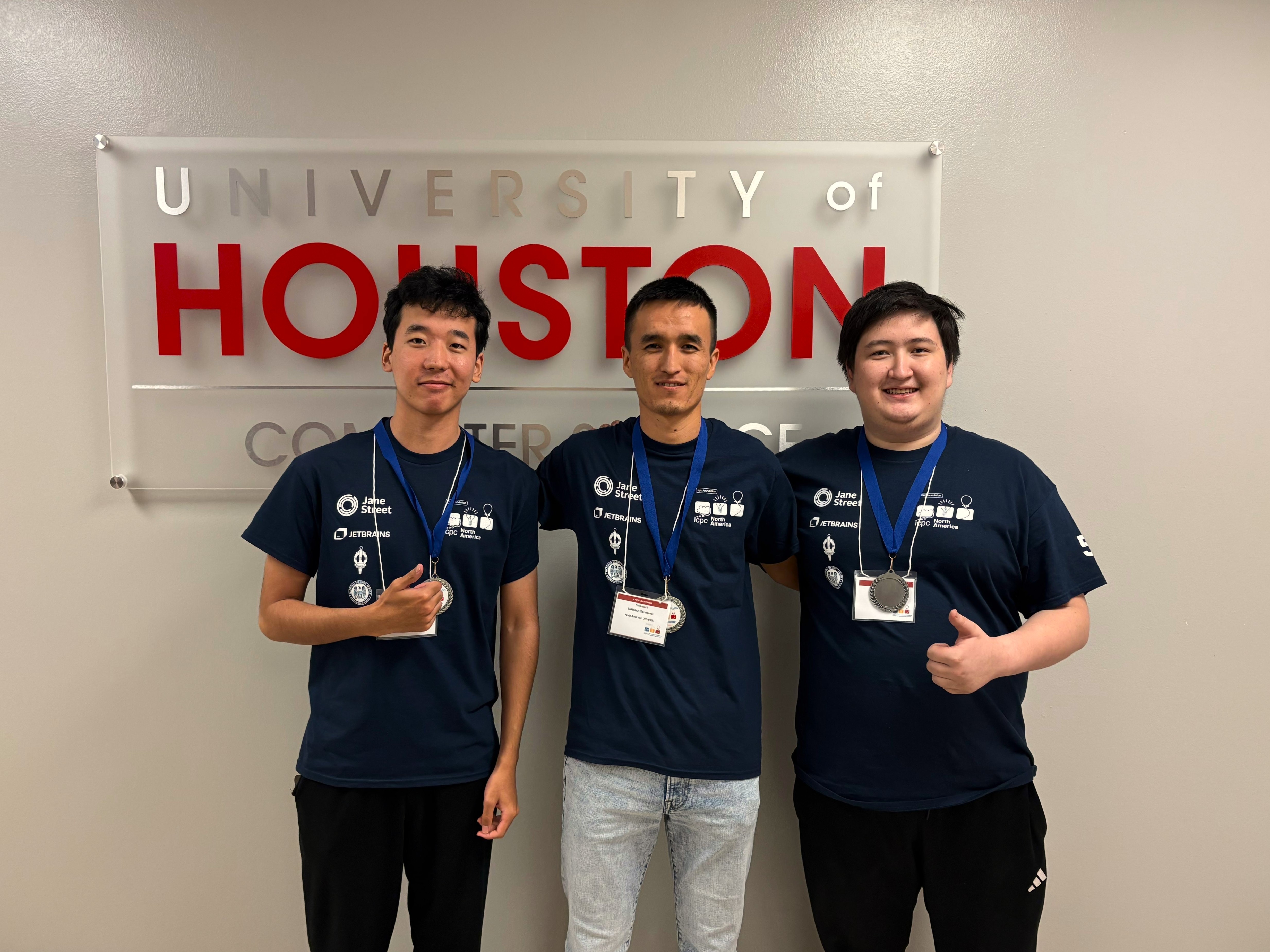
After five hours of competitive programming, the NAU Stallions, (from left) Aktan Ruslanov, Bekbolsun Samaganov and Asylbek Ismailov, pause at the University of Houston during the ICPC North America South Division in early November 2025.
Summary: At the University of Houston, three students from North American University joined 155 teams across the region in the International Collegiate Programming Contest. Competing under intense time pressure with a single laptop, the team learned that growth doesn’t come from feeling ready, but from showing up, persisting through uncertainty, and discovering who they are becoming together.
It’s November 8, and inside a lecture hall at the University of Houston, the NAU Stallions—a team of three Kyrgyz students from North American University—are deep into the five-hour grind of the International Collegiate Programming Contest North America South Division. Across the region, 461 competitors, making up 155 teams, are working through the same 13 problems at the same time.
At the team’s sole laptop, Asylbek Ismailov stays locked in, fingers racing across the keyboard, while teammates Aktan Ruslanov and Bekbolsun Samaganov hover nearby—sketching out approaches, crossing them out, leaning in again to rethink solutions from scratch.
More than four hours into the contest, they’re rattled. They’ve solved three problems and made multiple attempts on others. The clock on their screen keeps shrinking. With one hour left, they make a risky decision: go for two more problems at once, hoping to climb higher in the standings.
Ismailov pauses just long enough to steady the team. “You have to keep the momentum and not die mentally in the middle of the contest,” he says.
For the NAU Stallions, ICPC is teaching them something that no classroom can fully prepare anyone for: growth doesn’t happen when one feels ready. It happens only after stepping forward anyway—under pressure, alongside others, and learning through effort and failure. As the clock winds down, they begin to understand what they have already gained: learning happens when people face uncertainty together, persist through difficulty, and discover who they are becoming along the way.
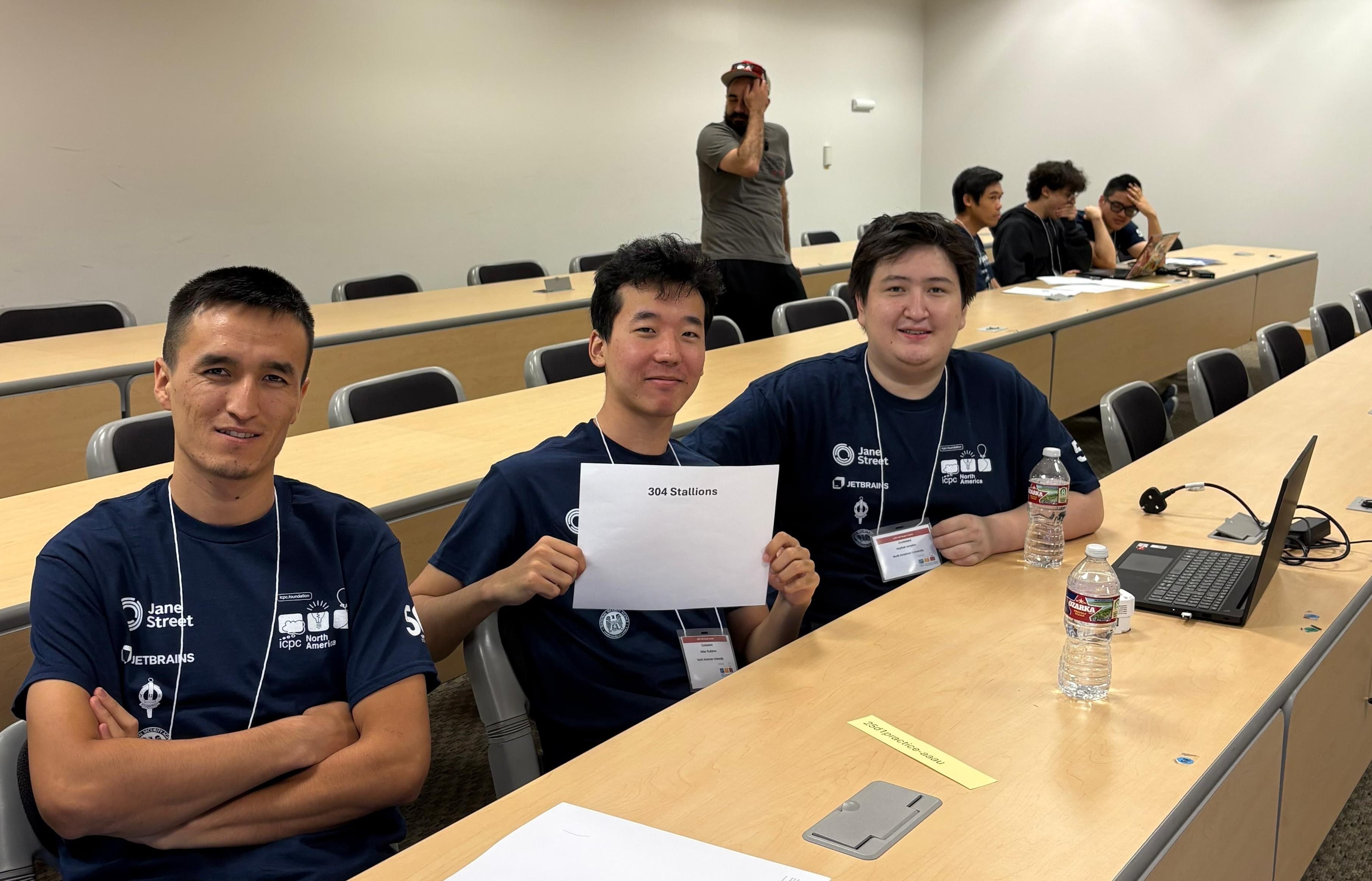
Team NAU Stallions pose for a photo moments prior to the ICPC Programming Contest North American South Division, held at University of Houston, November 8, 2025. Photo courtesy of Bekbolsun Samaganov
First held at Texas A&M University in 1970, the ICPC has since grown into an international competition that sees three-member college teams from more than 100 countries compete each year. Teams advance through local and regional contests to regional championships, with only a small fraction ultimately qualifying for the World Finals.
The competition reflects the highest standard of algorithmic problem-solving, teamwork, and practical coding, according to Ihsan Saiid, chair of the Computer Science Department at NAU. More than a test of technical skill, he says, ICPC pushes students to stretch themselves intellectually and personally. “In those moments,” Saiid says, “technical knowledge alone is not enough—what matters is the ability to reason clearly, prioritize effectively, and act decisively.”
Although the three students competing as the NAU Stallions came together just two weeks before the ICPC North America South Division contest, each had spent years developing problem-solving skills along very different paths. At 22, Bekbolsun Samaganov, the oldest of the three, knew he needed to recruit teammates stronger than himself when he first conceived the idea of competing in ICPC 2025. While he had competed successfully in math Olympiads throughout middle and high school, he had only been coding for about three years. “I had to reach out to people who were stronger than me,” he says. “There was always the risk of rejection or failure, but I chose to move forward anyway.”
That outreach led him to Asylbek Ismailov and Aktan Ruslanov, both 19. Ismailov brings deep experience from international informatics Olympiads in Kyrgyzstan, including a bronze medal at the Zhautykov International Olympiad in Almaty, Kazakhstan. Even so, he doesn’t consider himself fully prepared. “I was completely out of the competitive programming field for a couple of years, and I forgot the schedule of Olympiads,” Ismailov admits. “I wasn’t in my best shape.”
Ruslanov, who began studying computer programming in seventh grade, carries similar uncertainty. Years of training offers no guarantee they will translate cleanly into a new team dynamic. But the chance to compete together, he says, shifted his mindset. “When I am competing with the team, I’m trying harder, because it’s for my team,” he says. “It’s not just for me.”
The three forged ahead anyway, knowing they would never thrive with quitting as an option. Instead of waiting for confidence to arrive, they focused on building momentum through repetition and work. Samaganov traces this mindset back to his first bootcamp, where days blurred into long hours of coding under the close watch of a mentor who refused to let frustration become an excuse. Failure was expected. Stopping was not. “The most important thing my mentor taught me,” Samaganov says, “was to never give up.”
Saiid sees the same pattern play out in competitive programming. Perseverance, he argues, moves students away from fear of failure and toward understanding and mastery. Progress arrives not from breakthroughs but from gradual accumulation. “Start small, practice consistently, work with peers,” Saiid says. “Focus on improving step by step rather than winning immediately.”
Coming from half a world away to study in the United States, far from family and friends, has forced all three students to adapt early—often without a safety net. That experience, they say, shapes how they approach ICPC. For Ismailov, the instinct to persist comes from home. “We don’t call locksmiths,” he says. “We try to fix things ourselves.”
Samaganov feels a similar responsibility, but outward facing. Identity, for him, carries weight. “When I introduce myself as Kyrgyz,” he says, “I’m representing Kyrgyz people.”
Saiid sees competitions like ICPC as especially formative for international students. The shared struggle, he says, creates connection. “It provides a shared purpose and community,” Saiid says, “helping them feel connected despite being far from home.”
Back at the contest, time has slipped away from the NAU Stallions. They don’t advance to the next round. The result is unsatisfying but not defeating. For Ismailov, this feels less like an ending than an entry point. “It is a long journey,” he says, “and there is no stop for it because ICPC is every year.”
From an educator’s perspective, Saiid sees their participation as a success. What matters most isn’t their final placement, he says, but how the team works — the discipline they show, the way they stay engaged under pressure. One moment, in particular, stands out: “Watching the team celebrate a hard-won solution, capturing their determination, teamwork, and joy in overcoming challenges — a memory that embodies the spirit of ICPC,” he says.
The team may have come up short on the scoreboard, but as Samaganov reflects on the five-hour stretch, he measures the day differently. “In the end,” he says, “these experiences are something I’ll remember proudly.”
Then he adds, simply, “I choose to move forward anyway.”
Read more student-centered stories here.