Turan Uyghur Kitchen in Houston: Qorma Chop, Uyghur Culture and Thanksgiving Gratitude
From Kashgar to Chinatown, this Uyghur restaurant shows how gratitude lives through food, faith and daily action.
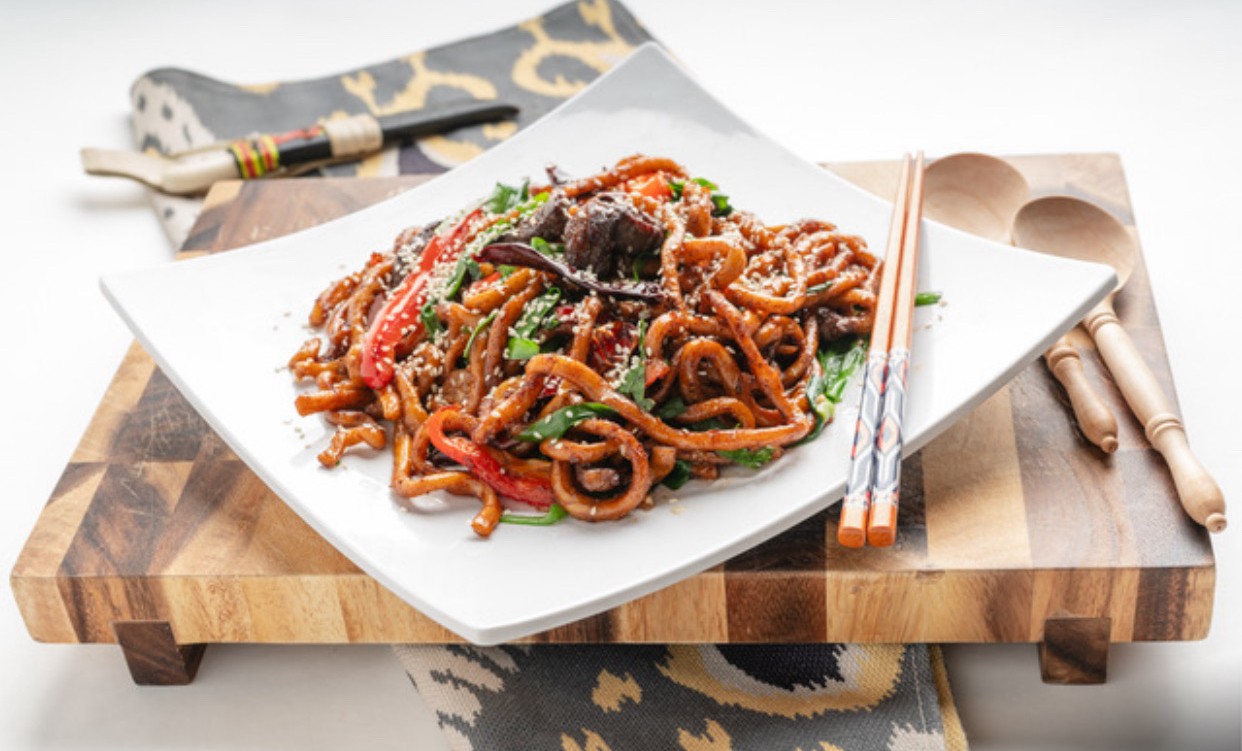
Photo courtesy of Turan Uyghur Kitchen
Before the first guests arrive, Turan Uyghur Kitchen is already alive with tea, work and intention. This story explores how gratitude, sacrifice and Uyghur culture live through food, hospitality and the signature dish Qorma Chop—offering a deeper meaning of Thanksgiving beyond the holiday.
Two and a half hours before the first customer walks through the door, Turan Uyghur Kitchen has already come alive. In Houston’s Chinatown, the storefront remains still, but inside, the restaurant moves with the certainty of a place already at work. Tea begins to steam near the counter. Tables come into order. Spices are measured. Storage shelves are reorganized.
.jpeg&w=3840&q=75)
In the middle of that movement, one figure slows the pace. Restaurant manager Luqman Sajad Mohamed, a first-generation American, steps away from his tasks and pauses. Before sitting down, he places an Uyghur doppa on his head, then pours tea and offers it the way Uyghur hospitality is practiced—simply, without announcement. For Mohamed, that small gesture carries meaning. He explains that “trust for gratitude is really important, because in order to see someone, in order to be thankful for someone, you have to trust that their intentions are good.”
That trust—and the spirit of Thanksgiving that grows from it—takes shape through the sacrifices Mohamed demonstrates with his staff every day. On a typical morning, he prepares his smoothie specialties for them, makes breakfast or shares the home-brewed milk tea his wife sends with him to work. These gestures of generosity are part of how he shows up before any guest has even ordered.
Mohamed learned that way of giving from his boss, Alimjan Omar, the owner of Turan Uyghur Kitchen, who later joins him for tea. Rather than directing from a distance, Mohamed describes a man constantly sharing his time and energy. “The way he is always teaching people, … always coaching them, doing everything,” he says of Omar’s presence in the restaurant, “shows bigger than just someone crossing their arms and giving orders.”
Born and raised in Kashgar, in East Turkistan, Omar traces his journey back to 2011, when he worked as an urban design engineer in Suzhou, China. There, he regularly met business travelers from his homeland who struggled to find halal food and dignified lodging. In response, he rented and transformed a seven-story building into a community hub—with a halal restaurant, grocery store, masjid and guest rooms—so people could eat, speak their language and practice their religion in peace. As he recalls, “that inspired me to open a place that served a real purpose, not only for profit but to bring comfort and dignity to my community.”
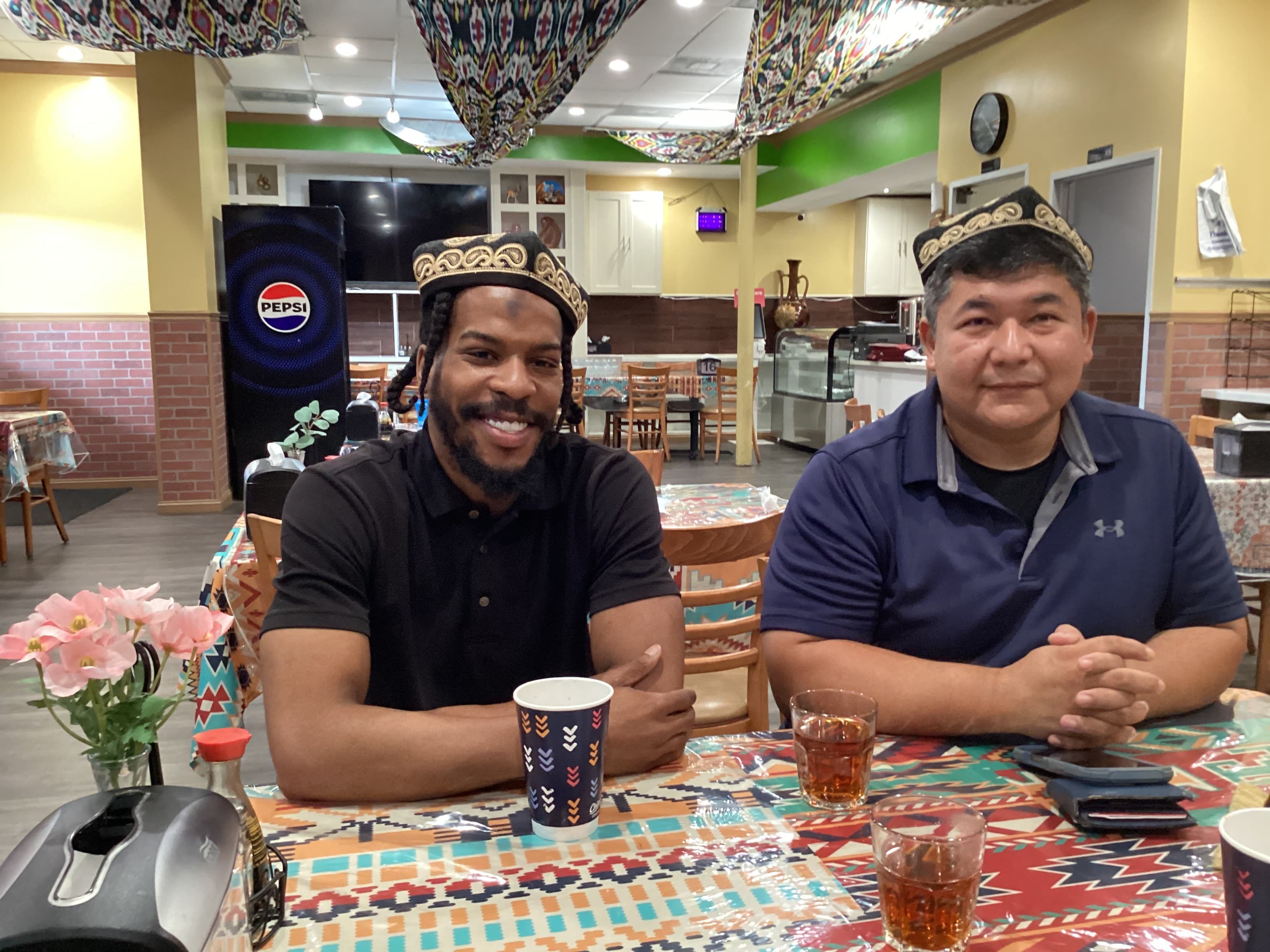
From left to right, Turan Uyghur Kitchen Manager Luqman Sajad Mohamed and owner Alimjan Omar.
Omar moved to the United States a few years later. After spending almost a decade settling into life here, in 2023 he decided to repeat what he had learned in Suzhou—using food to help displaced communities hold themselves together. He had seen how halal restaurants could become more than businesses: they became places of refuge for people trying to stay grounded in their religion, language and culture. With that vision, he opened the first Turan Uyghur Kitchen in Plano, Texas, just outside the Dallas–Fort Worth area, followed a year later by the Houston location.
Turan addresses two urgent needs facing Uyghurs in the region. Its zabiha standards ensure the restaurant’s meat came from animals slaughtered according to Islamic law, while its Uyghur dishes help fill a cultural and emotional gap many in the community have long felt. “Food is powerful,” Omar says. “It brings people together and opens the door to meaningful conversation. That is the mission of Turan.”
For Omar, food carries responsibility beyond flavor. Food, hospitality and community do not stand apart; together, they serve a greater purpose when offered with sincerity and shared with a community he deeply cares about.
It is precisely this example that shaped Mohamed’s commitment. He recalls feeling an immediate connection to Omar through Islam and through the Uyghur community’s struggle to preserve its identity. Now, as restaurant manager, he sees his role as educational as much as operational—helping guests understand the stories, histories and meanings folded into each dish. “I feel like a custodian, helping keep their name alive, helping keep their culture alive,” he says.
Since joining Turan in May, Mohamed has watched relationships among staff deepen through shared effort. He mirrors Omar’s sacrifices through daily, often unseen acts—making breakfast for coworkers, blending smoothies, sharing the home-brewed milk tea his wife prepares. As he reflects, “being around someone who carries himself with the awareness that everything he does is seen and accounted for pushes you.”
But culture alone does not fill tables. Taste does.
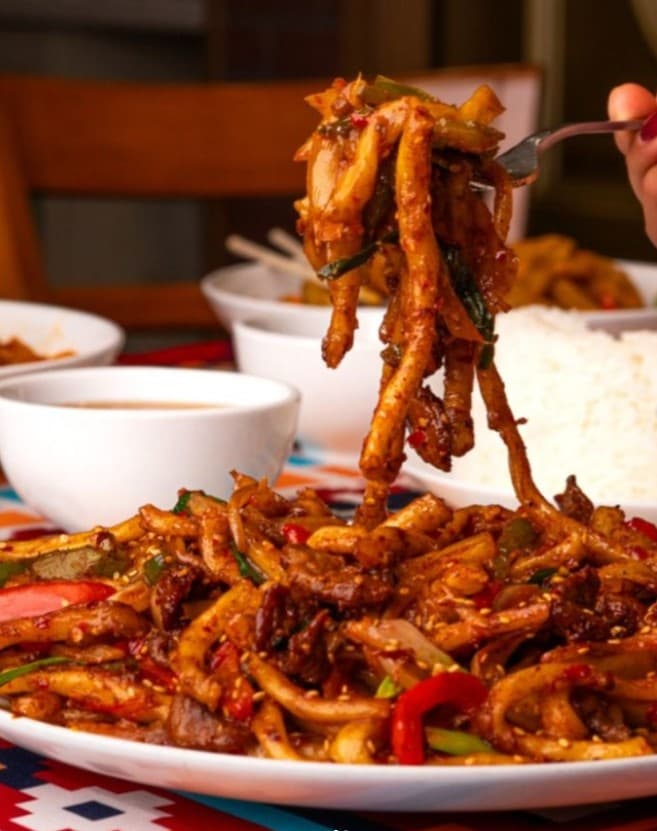
Unlike laghman, where noodles and sauce are served separately, Qorma Chop brings everything together in the pan. The hand-pulled noodles are steam-fried with meat, onions, bell peppers, garlic and chives, absorbing a rich blend of spices. The defining flavor comes from peppercorns—whole and leaf peppercorns fried, dried and ground by hand to create its signature aroma and heat. Photo courtesy of Turan Uyghur Kitchen
At Turan Uyghur Kitchen, that taste often arrives on one plate: Qorma Chop. Qorma Chop is available daily at Turan Uyghur Kitchen in Houston’s Chinatown, served as both a single plate and in larger trays for families and gatherings.
Omar describes the dish as a variation rooted in Laghman, the iconic Uyghur hand-pulled noodle dish, shaped by centuries of cultural exchange along the Silk Road. For him, Qorma Chop reflects Uyghur history itself—layered, adaptive, in motion—because, as he explains, “food is often a wonderful product of cross-culture exchanges.”
Unlike Laghman, where noodles and sauce are served separately, Qorma Chop brings everything together in the pan. The hand-pulled noodles are steam-fried with meat, onions, bell peppers, garlic and chives, absorbing a rich blend of spices. The defining flavor, Omar notes, comes from peppercorns—whole and leaf peppercorns fried, dried and ground by hand to create its signature aroma and heat.
The real appreciation for Qorma Chop rests in the patience required to get that perfect noodle—the same patience that governs everything in this kitchen long before the first customer arrives. Authenticity, he insists, begins with the dough. “Freshly kneaded dough and hand-pulled noodles are what make it authentic,” he says. “Store-bought noodles may look similar, but you can immediately taste the difference in freshness and flavor.”
That patience has paid off. Qorma Chop has become one of Turan’s most requested dishes among non-Uyghur patrons. Omar smiles when describing customer reactions, explaining that “they will tell us, ‘This dish is amazing.’ We know they enjoy it because when the plate comes back, there is nothing left.”
He believes Qorma Chop belongs naturally on a Thanksgiving table because of its versatility. It can be mild or spicy, served with beef or chicken, and paired alongside traditional American dishes without overwhelming them. As he says simply, “even children like it. It brings people together, and that’s what matters.”
For Omar, the dish carries personal meaning beyond popularity. “It feels relaxing to me,” he reflects. “With other meals, someone always dislikes something. But Qorma Chop is the one dish that makes everyone happy.”
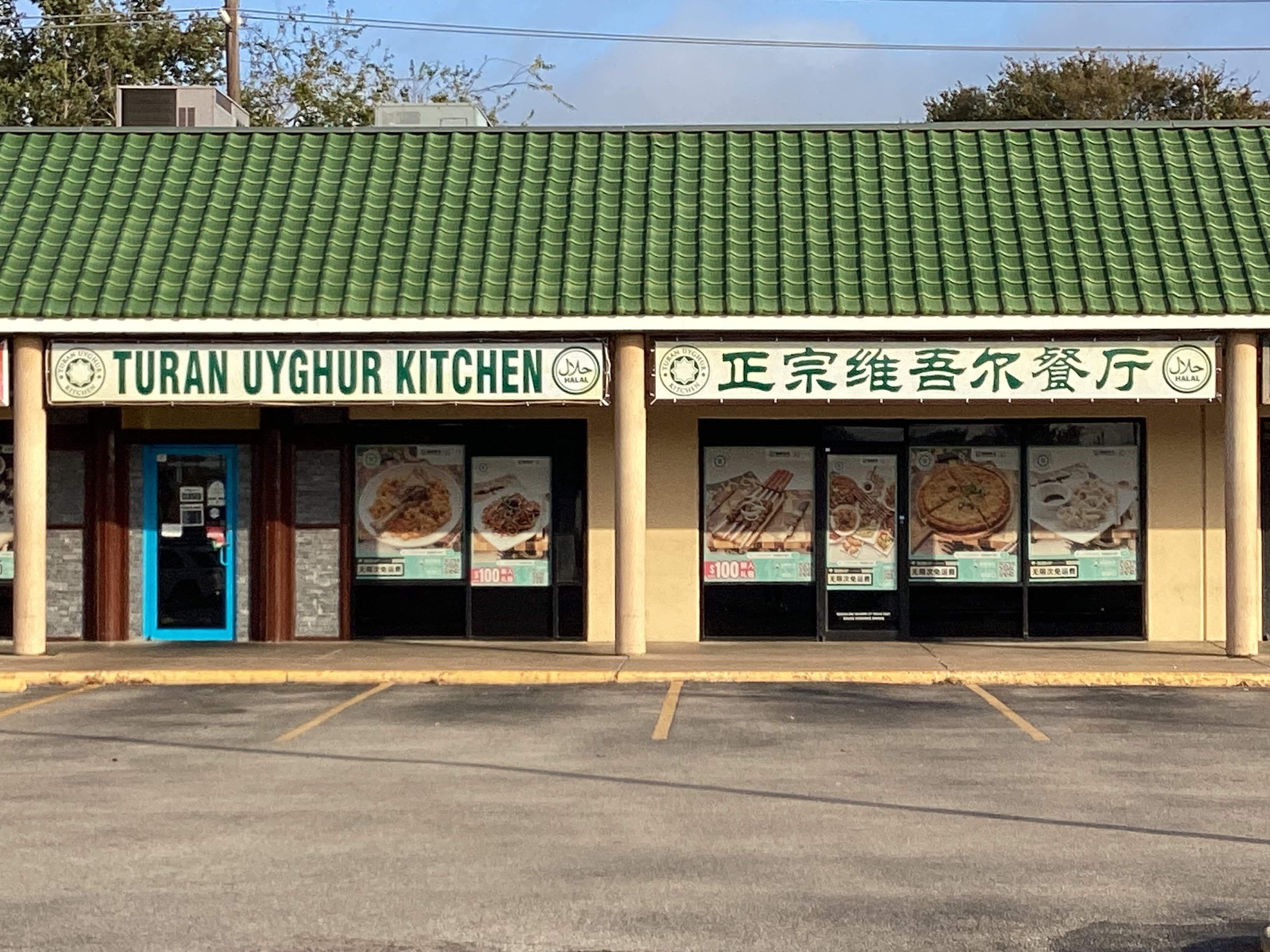
Turan Uyghur Kitchen, located in Houston’s Chinatown on Bellaire, brings together food, hospitality and community through acts of gratitude.
As the kitchen stirs back into motion, Omar lifts a thermos filled with the milk tea Mohamed’s wife brewed earlier that morning and pours two cups—one for himself, one for his manager.
In Uyghur culture, gratitude is not something announced. It is performed.
Omar often returns to a Uyghur proverb: “Bendige rehmet eytmighan, Hudagha shukur qilmas”—the one who doesn’t thank the creature also doesn’t thank the Creator.
For Mohamed, that proverb doesn’t live in framed calligraphy or rehearsed speeches. It lives in action—in picking up what others leave behind, in serving coworkers before serving guests, in refusing to step away during inspection week. Gratitude, he believes, is proven through the small, unannounced acts people repeat when no one is watching.
And at Turan Uyghur Kitchen, where Mohamed and Omar—both wearing doppas—take their final sips of milk tea before rejoining their coworkers, those acts have already begun long before the doors ever open.
Qorma Chop Ordering Information
Qorma Chop (beef or chicken) — $16.95 per plate
Large Qorma Chop tray (serves ~15 people) — $168