When Children Hold the Camera: Daniil Usmanov on Migration and His Latest Exhibit, Valley of the Winds
In Valley of the Winds, documentary photographer Danil Usmanov handed disposable cameras to children in Kyrgyzstan’s Batken region. In this Q&A, he reflects on migration, authorship and what emerged when he stepped back.
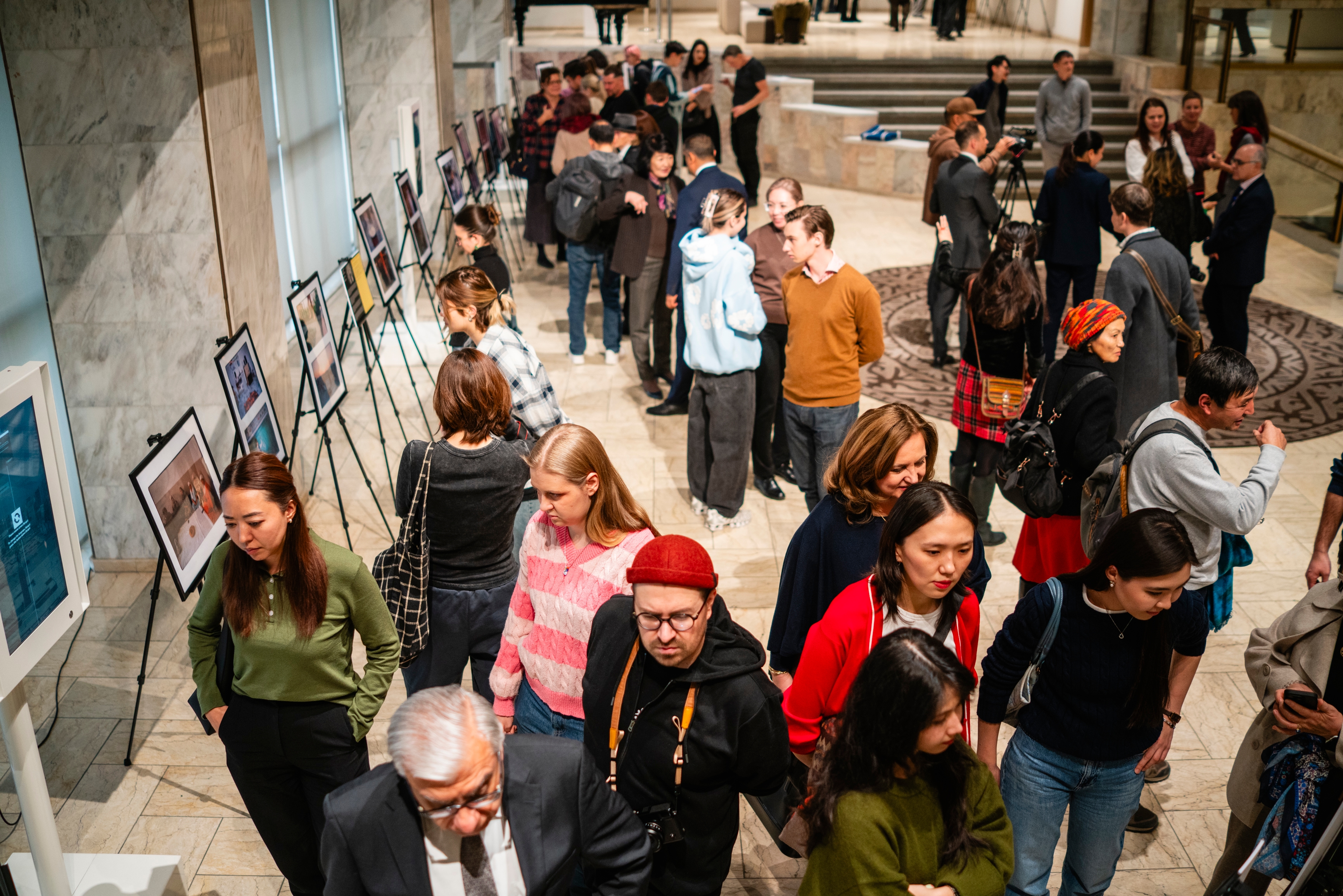
Attendees at the grand opening of Valley of the Winds, a photo exhibition curated by photographer Daniil Usmanov. The exhibit features photos of Batken, Kyrgyzstan, through the eyes of children. Photo courtesy of Daniil Usmanov
In Valley of the Winds, documentary photographer Daniil Usmanov handed disposable cameras to children in Kyrgyzstan’s Batken region whose parents work abroad. In this interview, he reflects on authorship, migration, and what emerged when he stepped back.
What happens when children are given disposable cameras and asked to document their own lives?
That question sits at the center of Valley of the Winds, a photography project by 30-year-old documentary photographer Daniil Usmanov, presented in October and December 2025 as part of the international “Solitude: Loneliness and Freedom.”
Supported by the Embassy of France in Kyrgyzstan and the Goethe Institut as part of a joint Franco-German cultural initiative, the project developed in Kyrgyzstan’s southern Batken region, an area shaped by long-term labor migration, border tensions and environmental pressure. Rather than photographing children whose parents work abroad, Usmanov handed cameras to three children and stepped back. The photographs they produced form the core of the exhibition.
Valley of the Winds is expected to travel internationally in the coming months.
Edgu Bilig spoke with Usmanov about how the project took shape, what surprised him in the images the children made, and what it meant to relinquish control as a photographer.
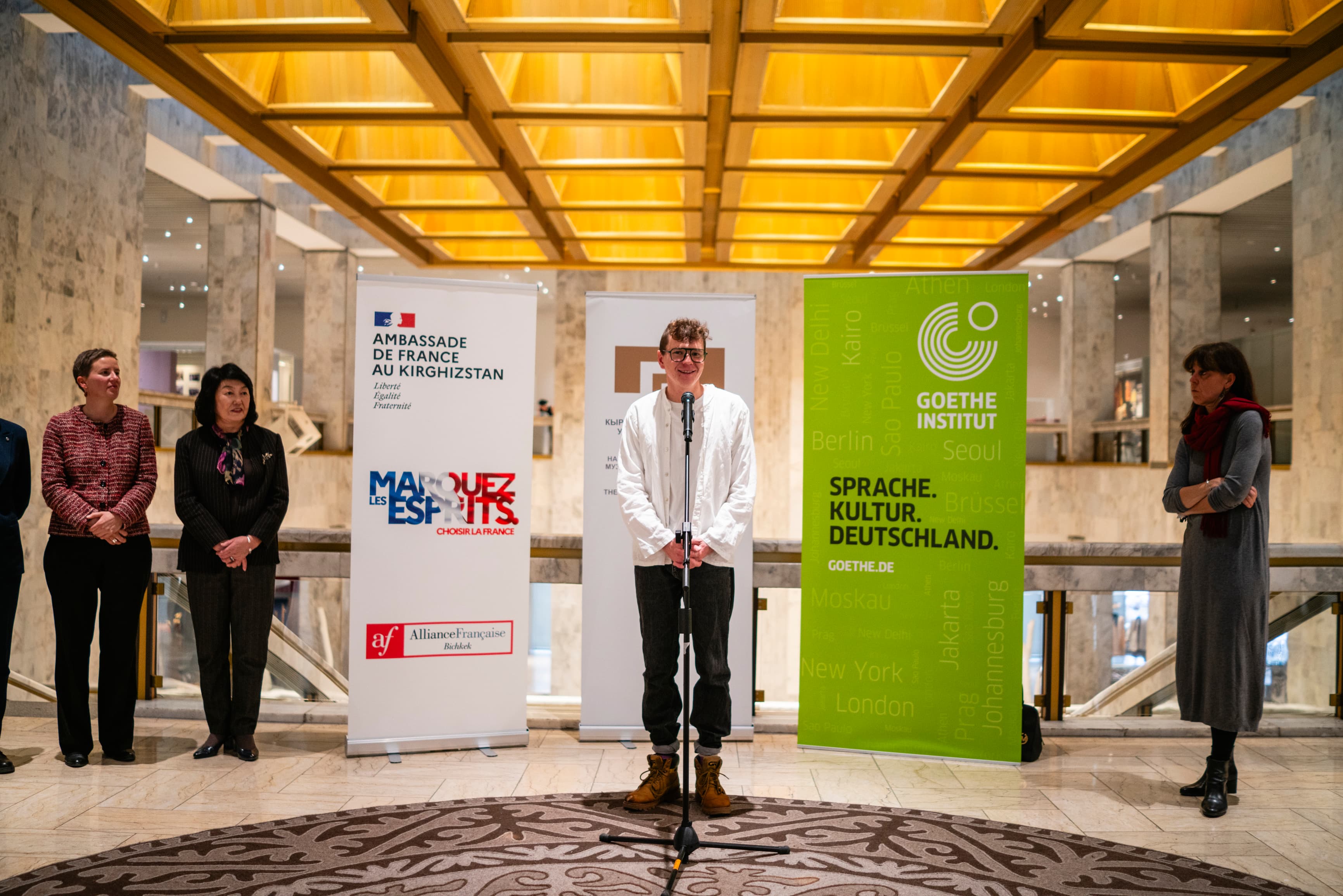
Photographer Daniil Usmanov speaks to attendees of the grand opening of his most-recent exhibition, Valley of the Winds, in Bishkek, Kyrgyzstan. The exhibition, supported by the Embassy of France in Kyrgyzstan and the Goethe Institut, centered on photos by children who were handed disposable cameras to capture life in a community shaped by labor emigration. Photo courtesy of Daniil Usmanov
You’ve been working as a documentary photographer for about 12 years. How did you begin?
I started from a newspaper in Bishkek. In the beginning, I was a photojournalist, like a photocorrespondent. The first years were interesting, but later it became the same work again and again. Mostly it was about things that don’t work in the city—broken infrastructure, simple problems. I wanted to go outside the city, outside the region, but it wasn’t the best time for the newspaper.
I liked it, but I became tired of that format, and later I became a freelancer and started working on different topics.
Where did you study photography?
It was difficult. When I was in school, I looked for photography schools, but they were commercial. My family couldn’t afford it. I asked if I could come for free, but of course it’s a business.
There was a good photography community at that time. George Kolotov had a school, and there were lectures and events. I visited those. There were many photographers, and it was interesting.
I went to the University of Culture and Art. I’m a cameraman by education. I tried Manas University, but I didn’t pass the test. There were questions about biology, and we never studied that in school. Now a friend who teaches photography at Manas invites me to speak to students sometimes.
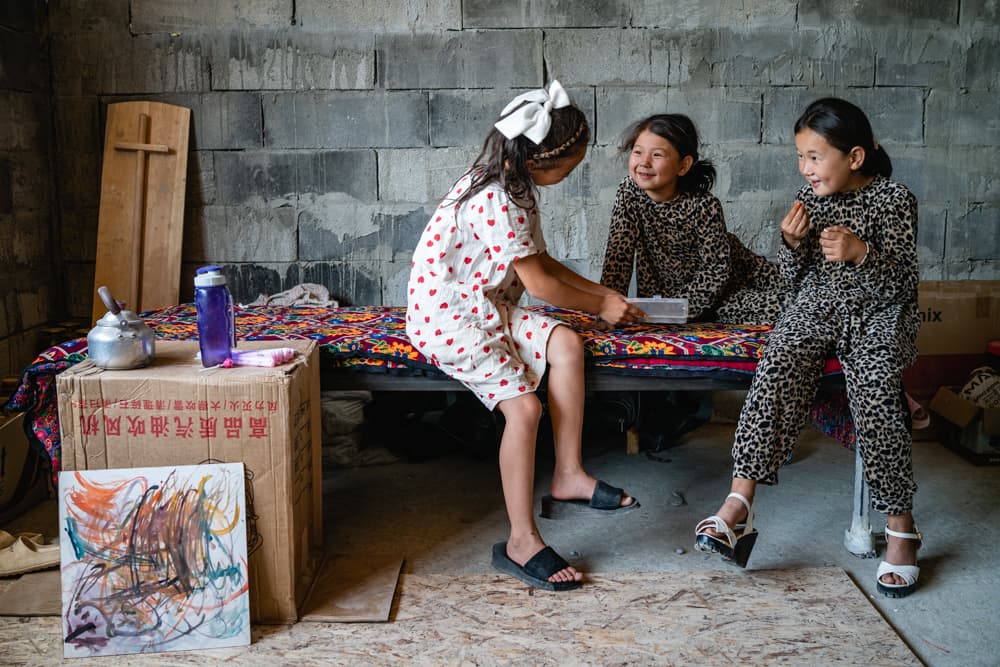
Daniil Usmanov photo in Batken of Nazbiike Nurgazieva for the exhibit Valley of the Winds. Nurgazieva, 8, plays "house" (mothers and daughters) with her friends at home, where she lives with her grandparents in Irilesh village, Kadamjay district. In the scenario of their game, the father has left for work. Photo courtesy of Daniil Usmanov
At some point you began studying documentary photography more seriously. How did that happen?
I had friends from Uzbekistan, and one of them came to Bishkek with his friend, Timur Karpov, a photographer from Tashkent. We went to Osh Bazaar early in the morning and photographed how the market opens.
Later we were sitting near Manas on Kievskaya Street, and he asked me what I was doing. He said, why didn’t you go study documentary photography? He had just returned from Moscow, where there was a strong photography community. He told me about the Dog-Doc-Doc School of Documentary Photography.
The open call was already finished, but I wrote to the director, and they allowed me to join. It was online, before coronavirus. I studied there, did a project, and published it. After that, I had a conflict with my newspaper because they didn’t like that I worked for another outlet. I left and became a freelancer.
Why did you choose Batken for Valley of the Winds?
I just needed to choose one region, because if I tried to do the whole of Kyrgyzstan, I wouldn’t make it in time. Batken made sense because of the demographics. I heard it’s one of the oldest areas, so I thought there would be a bigger chance to find families who would agree to participate in the project.
I had been there often already, so for me it was clearer. I just pointed, kind of, and said: let’s do it in Batken.
How did you find the girls who participated in the project?
I was driving in Batken and stopped in Jenish. I noticed new houses being built, and the government there is trying to bring migrants back. Seeing that, I stopped and started asking people if they knew families where children live with grandparents because their parents are working abroad.
One man invited me for tea. I explained the project, and the family agreed. They called their niece, and I left a film camera with her. I came back several times.
Later, on the way to Zardaly, I met another family near the road. In that village, almost everyone goes to Yekaterinburg for work. And the third girl was from Borborduk, on the border with Tajikistan. My friend Sarvar helped connect me to her. In some communities it’s difficult to enter homes, but when the girl herself has the camera, it changes everything.
Why did you decide to give the girls cameras instead of photographing everything yourself?
I didn’t want to follow them all the time. If an adult is always there, children stop behaving naturally. I didn’t want them to see me as an adult who is watching.
With film cameras, they were free. I just showed them how it works. I didn’t tell them what to photograph. For me it was interesting how they see the world around them.
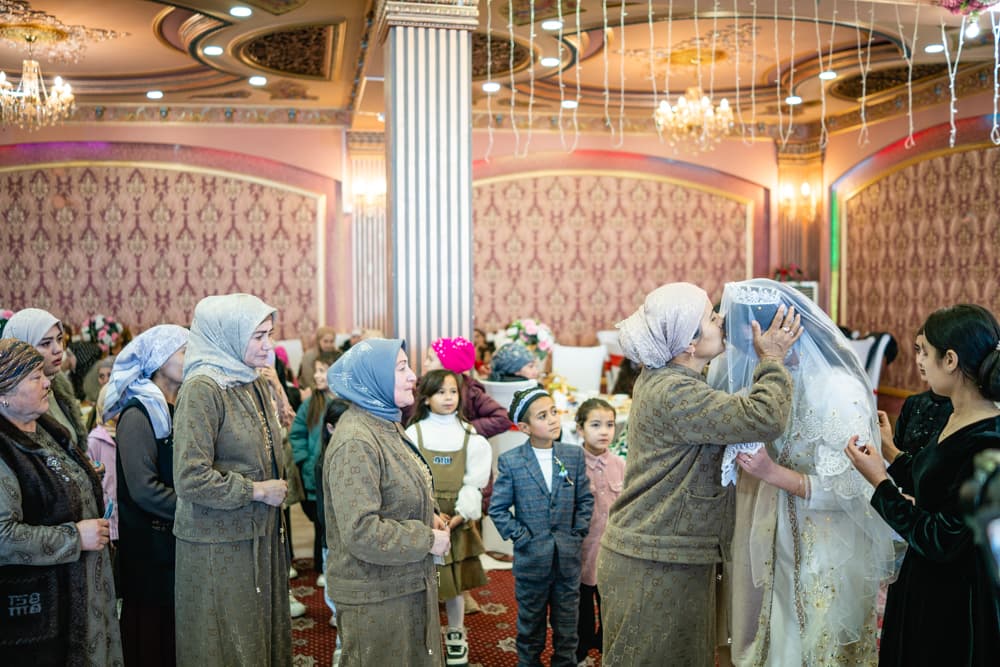
Wedding in Batken, Kyrgyzstan, captured by Sarvinoza Toirova, 11. The photo was featured in the exhibit, Valley of the Winds, curated by Daniil Usmanov. Toirova’s grandmother Sobira and her sisters say goodbye to her aunt at a wedding in a restaurant opposite the Kanibadam highway, which was fenced off with barbed wire after the establishment of the border with Tajikistan in the village of Borborduk. In the background is her brother Otabek after the morning sunnat-toy (circumcision celebration), organized by their parents who arrived for the holidays. The groom could not come, so the second part of the wedding will be held in Moscow, where almost all the local youth go to work. Residents say that their rural ayyl aymak (municipality), Jany-Jer, has become a dead end. Photo courtesy of Daniil Usmanov
Was there a moment when you realized the project was becoming something different from what you first imagined, especially after seeing how the girls used the cameras?
When I went there, I had a different expectation. I didn’t know how the children would photograph, and I didn’t want to influence their view. I just gave them the cameras and let them shoot.
I thought it might be more like a modern style. I see how children shoot for Instagram sometimes, and usually it’s more like simple memory photos. But when the time came to develop the film and I sent it to Bishkek, I was very happy when I saw the scans.
The photos were really good. They weren’t only about themselves, but also about their surroundings. Only one girl was doing a lot of selfies, more like Instagram style. I asked her if she could also show what was around her, and later we were together at a wedding, and she photographed that too.
After that, I decided that the children’s part should be bigger than my own, because it was much more interesting to see their perspective.
What surprised you when you saw the photographs?
I thought there would be maybe just a few good photos from them, and the rest would be my exhibition. But when I sent the film to Bishkek for developing and scanning and saw the results, I was pleasantly surprised.
In the end, my photos were maybe 25 or 30 percent of the exhibition. The rest were theirs. I didn’t teach them much. I just showed how the camera works. I wanted it to be free.
My favorite photo is a girl jumping—only half of her body in the frame. For me it was clear what was happening, but not for everyone, so we added a caption.
Where was the project exhibited?
We did an exhibition on October 1 in Batken during a national museum festival. Museum workers from all over Kyrgyzstan came for exhibitions, lectures, and conferences. We opened the exhibition within that festival. Ambassadors also came.
I invited all the girls to come, but only one was able to attend. We presented diplomas, certificates, and printed photographs. For the others, I later went to their villages. In one case, I presented a certificate at a school lineyka. In another village, the whole community was at a wedding, and I asked if I could speak and present the certificate there.
How did the girls experience daily life while their parents were away?
For children, I think it’s different. As long as there is an adult they can rely on—grandparents, for example—they don’t pay so much attention to the fact that their parents are gone.
What did you learn from this experience?
For me, it was about watching their living situation. At first, I felt sorry for them. But they enjoy the life they have and don’t complicate things. They still have happy moments. Maybe they don’t have everything they want, but they don’t complain. They see good things around them and take the best from what they have.
How did this project connect to your own childhood?
We lived in Karakol [in north Kyrgyzstan]. My mother worked several jobs, and my father was often away trying to make business. We were a big family—four children. I was the youngest, and I was often alone at home. It was a lonely time. I saw my father very rarely.
Later we moved to Bishkek and tried to live there.
What are you planning to work on next?
I want to go back to Batken and work on a project about glaciers and global warming. There are serious problems with water. Young people don’t want to live in some villages because they’re losing their gardens.
People didn’t really believe in global warming before, but now they notice something strange is happening. I think next year might be difficult for the region because the weather is changing, and water is the main problem.
Will Valley of the Winds be shown outside Kyrgyzstan?
Possibly. The project may be presented in Berlin in May, and there is also interest from France. For Europe, I think it’s important. There is a lot of anti-migrant sentiment, and this project shows that migration is not something people do for fun. They go to work and support their families back home.
Read this conversation about how Kazakh artist Assol uses historical figures on carpets to bring new appreciation for art.